
2026-04-02 Maundy Thursday
Grace, mercy and peace be to you from God our Father and our Lord and Saviour Jesus Christ. Amen!
“For the Lord will pass through to strike the Egyptians, and when he sees the blood on the lintel and on the two doorposts, the Lord will pass over the door and will not allow the destroyer to enter your houses to strike you” (Ex 12:23). There you go, folks. That’s the whole reason we have gathered here tonight at God’s house. On this night that is not like any other night, the Lord’s Passover was celebrated by our Lord Jesus and the Disciples. It was indeed a flashback, back to the Exodus, where God would deliver and redeem His people from slavery and bondage in Egypt.
We know the story quite well. Pharaoh would be trounced by the God of Israel. Divine plagues struck the land of Egypt at the hand of Moses. The final plague, the death of the first born, would strike Pharaoh personally. But God’s people were given the means to prevent this terrible plague from striking them. They had specific instructions. Take a lamb, without blemish, a male a year old. “The whole assembly of the congregation of Israel shall kill their lambs at twilight. Then they shall take some of the blood and put it on the two doorposts and the lintel of the houses in which they eat it” (Ex 12:6-7). The blood of the Lamb would cause the Lord to “passover” the house in which the faithful people were.
There is an interesting connection with this Hebrew word in the Old Testament. Pasach. It’s quite rare actually. It only comes up around seven times. Another place it is used is in the prophet Isaiah. In chapter 35 he writes “Like birds hovering, so the Lord of hosts will protect Jerusalem; he will protect and deliver it; he will spare and rescue it” (5). You miss this in our English translation, but this idea of “protecting” is the same word for ‘passover’. The visual is like a mother bird with wings outstretched, protecting her chicks from harm. No doubt our Lord is thinking of this in His lament for Jerusalem when He says “How often would I have gathered your children together as a hen gathers her brood under her wings, and you were not willing!” (MT 23:37). So the Lord protects His people from the passover plague. Kind of a neat connection in the text.
We can see both of these themes coming together in Holy Communion. Passover was indeed the setting where our Lord Jesus instituted the Lord’s Supper. In the midst of the telling of the greatest story of deliverance from the Old Testament, our Lord Jesus reinterprets the event as a Sacrament or mystery for us. The body and blood of the Lamb of God Who takes away the sin of the world are given and shed for His people to eat and drink. “For as often as you eat this bread and drink the cup, you proclaim the Lord’s death until he comes” (1Cor 11:26). Like the Passover, Holy Communion becomes the victory meal where we proclaim the Gospel itself. In the death of Jesus the Messiah, we have life. The plague of sin and death strikes Him on the cross, while we are protected. He endures the suffering and shame so that we might enjoy the feast of passover victory.
So we have all these strong themes of passover and protection in the context of Holy Communion. We have it in Paul’s letter to the Corinthians, we have it in the Old Testament reading from Exodus with the people being covered in the blood of the sacrifice and then eating and drinking with God. And then, we get to John’s Gospel and we have … scrub-a-dub-dub, stinky feet in a tub!
You kind of pause and wonder why this is the case. Why didn’t the lectionary people just pick the account of Holy Communion from Matthew, Mark or Luke? John is kind of the odd man out in that he doesn’t include the institution of Holy Communion like the other Evangelists do. And at first it seems truly odd. But then, the reason is revealed. Maundy means commandment. It’s like a mandate. And what is that mandate? “A new commandment I give to you, that you love one another: just as I have loved you, you also are to love one another” (JN 13:34).
Love is the interpretive lens to the entire Passion of our Lord Jesus Christ. This command in John 13 frames everything that follows: our Lord’s betrayal by Judas, His arrest, His trial and crucifixion, and of course, the crown jewel of the resurrection. All of this great love and mercy and grace for poor miserable sinners is embodied in a humble act of service.
The foot washing shows how disciples of Jesus are to love: by serving as Jesus serves, even to the point of laying down one’s life. Many smart Bible commentators note that John’s Gospel presents the entire passover upper-room event as an expression of love that culminates in the cross. And so this reading from John is chosen quite precisely to highlight what the protection, passover and peace of God come to mean as they are lived out in the lives of God’s people.
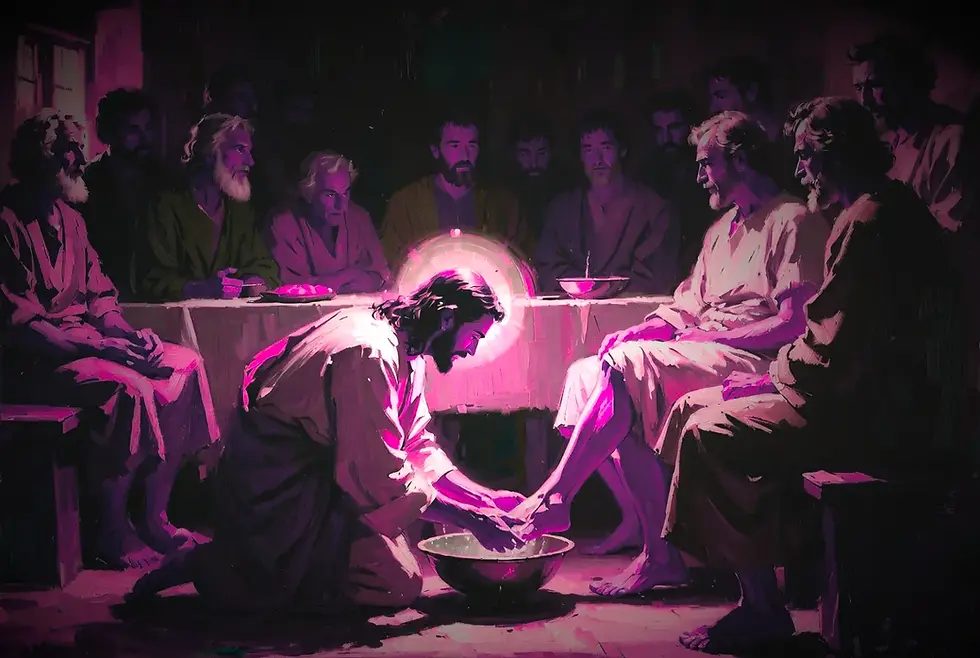
“He laid aside his outer garments, and taking a towel, tied it around his waist. Then he poured water into a basin and began to wash the disciples’ feet and to wipe them with the towel that was wrapped around him” (JN 13:4-5). In Saskatchewan, we are used to close toed footwear. Boots. Shoes. For like 9 months of the year. Now just imagine people dwelling in the desert. Open toed sandals. Heat. Sun. Sweat. Dirt. Bunions. Fungus. Gross. Everyone had gross feet back then. When you were invited over to a friend’s house, you walked there. Your feet were nasty. So as a sign of hospitality, the host would have the servants come and wash your feet for you. That way you could relax and enjoy the evening without worrying about the hosts’ family fainting from the mad donkey stench of your wee little piggies! But you caught the critical detail there right? The servants would do this dirty work. The host wouldn’t. The host’s kids wouldn’t. It was beneath them! Their blood was too blue for this nasty peasant’s job. But what did Jesus do?
Yes. He stoops down. He washes the disciples’ feet. He does the dirty work. The almighty master and creator of the universe does the work of a common slave. His humility shines like a diamond in the sun. The disciples are completely baffled by this. Peter is repulsed with the idea that Jesus would do this for Him. “You shall never wash my feet!” Peter cries. But Jesus calms his concerns. “If I do not wash you, you have no share with Me.” Jesus leaves for Peter and the others and us this amazing example. The Kingdom of God is not in glitz and glam and celebrity. Rather it is lived out in humble acts of service. Seldom do people understand this.
Really though, it changes everything. People who want to serve the Lord in their everyday lives think they need to become missionaries or pastors or full time workers in the church. But really it’s not that complicated. Shovel the neighbour’s sidewalk, carry in grandma’s groceries, make a lasagna for the grieving family down the street. It’s often these kinds of small little acts of humble service that most closely resemble the Kingdom of God. Everyone is capable of doing these kinds of things. Servant hearts that willingly scrub feet, these are the marks of the King and His followers. This how we see the blood of the Lamb on the doorposts of the heart.
This is the kind of love Jesus tells the disciples to have. They will be known by this agape love. If we are honest, we will look in the mirror of the Law and will not see a person who has been overflowing with love. Instead, we gaze into the eyes of a poor miserable sinner. Someone who has failed time and again to be loving to others, extending that same amazing grace that God has extended to us. And so we look to Christ our Lamb. We look to His example. He washes feet. He gives the commandment to love. We look to His cross, the place to where He is going. As we behold His great love, it begins to warm us like sitting beside a fire. The love of God enlivens our hearts and minds. The Holy Spirit in our Baptism and the Lord’s Supper transforms us into a people with servant hearts, ready to show that self-less agape love to all around us. Thanks be to God. Amen!


Comments